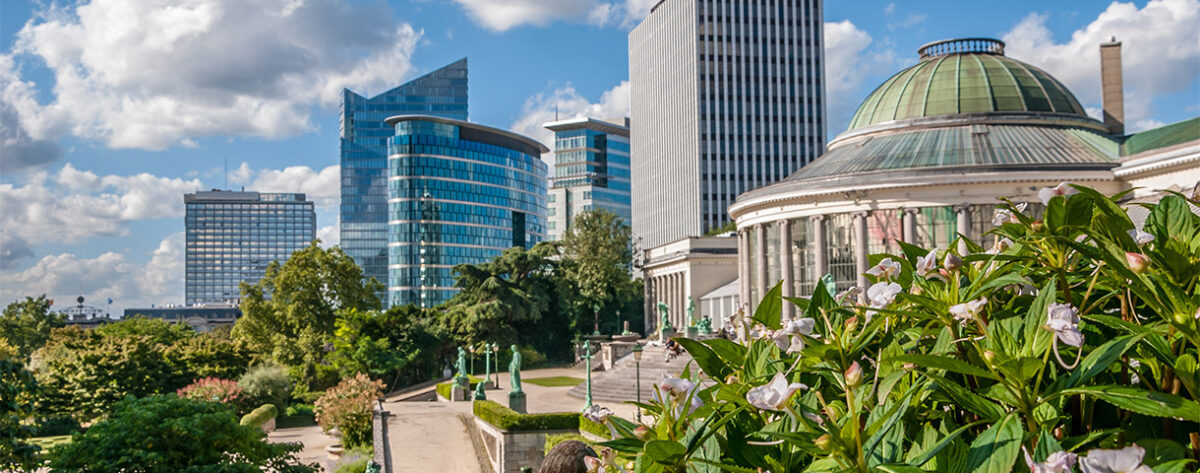
In 2026, our capital¹ continued to climb several international rankings, driven in particular by its economic performance and its research and innovation ecosystem. While these results reflect its attractiveness, they also highlight the challenges it still needs to address.
From New York to London and Paris, major metropolitan areas operate in an increasingly competitive environment. Against this backdrop, Brussels stands out in several areas.
Brussels in the global top 25
According to Oxford Economics’ Global Cities Index 2026, which assesses the performance of 1,000 cities worldwide based on various criteria (Economics, Human Capital, Quality of Life, Environment and Governance), the Brussels metropolitan area now ranks 25th globally, up from 34th in 2025 and 45th in 2024. The Belgian capital has thus climbed 20 places in just two years.
At European level, Brussels ranks 9th among capital cities, in a ranking led by London, Paris and Dublin.
Growing economic attractiveness
Brussels’ economic performance is one of the main drivers of this progress. The capital has climbed from 44th to 32nd place globally in the economic category of the Oxford Economics ranking (which takes into account factors such as GDP, economic stability, employment rates and economic diversity). It also ranks as the 6th best-performing European capital in this category.
However, this encouraging trend should not overshadow the difficulties faced by certain sectors, particularly retail, hospitality and construction.
Brussels has also made significant progress in governance, climbing 55 places globally, and in environment, moving up 32 places.
Research and innovation: Brussels among Europe’s leaders
Beyond its economic performance, Brussels stands out for the vitality of its research and innovation ecosystem.
In November 2026, the Brussels-Capital Region ranks 3rd in Europe in terms of participation in the Horizon Europe programme, behind Paris and Madrid, out of more than 1,200 regions assessed. It also ranks 5th in terms of funding secured through this European programme supporting research and innovation.
This ability to participate in research and collaborative projects at European level is naturally an asset in enhancing Brussels’ attractiveness.
The Regional Innovation Scoreboard 2025 confirms this position: Brussels is among the 38 European regions recognised as ‘Innovation Leaders’, alongside leading ecosystems such as Stockholm, Copenhagen and London.
A startup ecosystem gaining international recognition
Brussels also enjoys international recognition for innovative entrepreneurship.
In Startup Genome’s Global Startup Ecosystem Report 2026, Brussels retains its 20th place among the world’s 200 emerging startup ecosystems and ranks 5th among European capitals in this category.
Alongside ecosystems such as Madrid, Helsinki and Copenhagen, Brussels thus maintains a competitive position, although it has slipped one place in the European ranking compared with 2025.
Turning Brussels’ strengths into tangible opportunities
International rankings offer a valuable external perspective on Brussels’ position. The challenge now is to build on these strengths to enhance Brussels’ long-term attractiveness, attract new investment, support business growth, stimulate job creation and improve quality of life.
hub.brussels contributes to this ambition by supporting Brussels-based businesses in their growth and international expansion, as well as by helping to attract investment to Brussels.
* Please note that some rankings refer to Brussels as the Brussels-Capital Region, while others consider the wider metropolitan area (which includes parts of Walloon Brabant and Flemish Brabant and has a population of 3.4 million). For further details, please refer directly to the rankings.