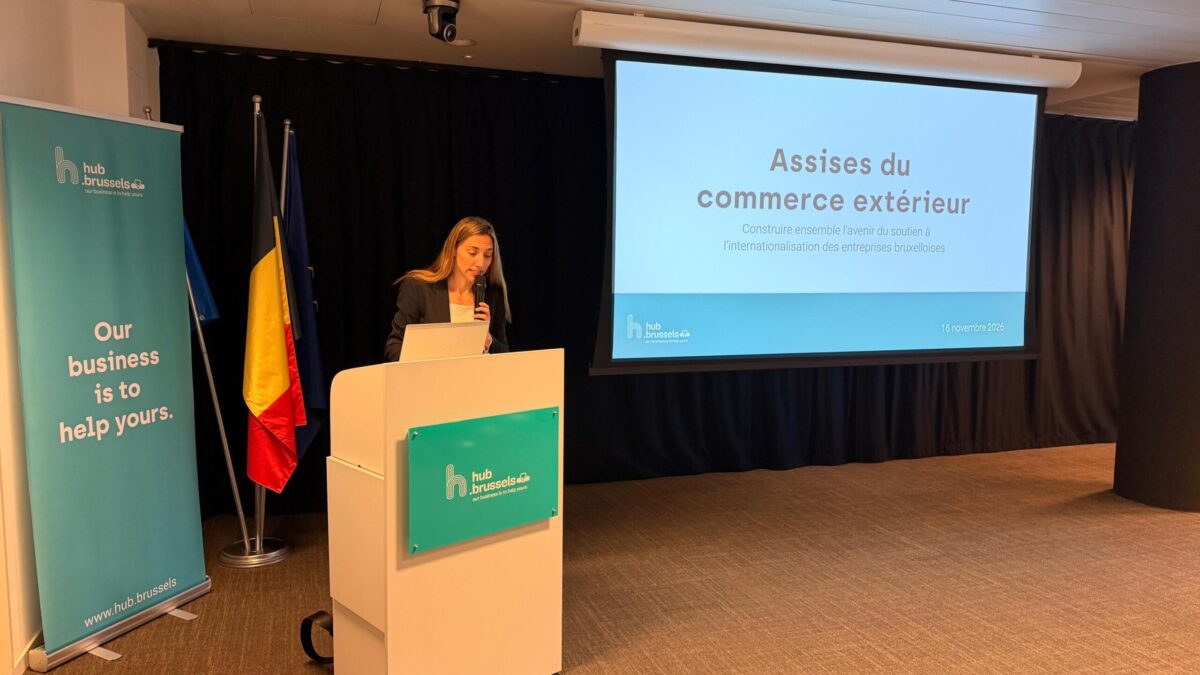
How can we better support Brussels businesses looking to expand internationally? How can we adapt existing services to their needs while taking economic challenges and budgetary constraints into account? To find collective answers to these questions, hub.brussels launched the Foreign Trade Forum on 16 November.
Internationalisation offers significant growth opportunities for Brussels businesses. But the environment in which they operate has changed dramatically in recent years. Geopolitical and economic tensions, rising costs, climate challenges and increasing international competition are making it harder to enter new markets.
At the same time, the budgetary constraints facing the Brussels-Capital Region are prompting us to rethink how we make the best use of available resources.
The aim of the Forum? To bring together businesses, institutional partners, chambers of commerce, and public and private stakeholders around a shared objective: identifying opportunities for greater cooperation and reshaping the Brussels model of internationalisation support to make it more effective and better suited to the realities businesses face.
Our goal is not simply to adapt our activities to a new budgetary framework. We also want to seize this opportunity to rethink our current model, explore how we can complement our partners’ efforts and identify more effective solutions for businesses.
Isabelle Grippa, CEO of hub.brussels
Putting businesses’ needs first
Over recent months, the hub.brussels teams have analysed the strengths of the current model and areas for improvement, explored different ways forward and exchanged insights with international organisations, including the International Trade Centre, Business France and Luxembourg Trade and Investment.
Because no support model can evolve effectively without taking into account the experiences of those directly concerned, namely businesses themselves, a survey was launched to better understand their needs, challenges and expectations when expanding internationally.
Among the needs highlighted were a clearer overview of the support available, more tailored assistance aligned with business objectives, and better value for money from the services provided.
6 challenges, 6 working groups
Building on these initial findings, six working groups were set up to test the proposed solutions against real-world business needs from 16 to 20 November:
Opportunities for interregional cooperation (with our Walloon and Flemish counterparts, AWEX and FIT).
Partnerships between public and private stakeholders (including chambers of commerce such as BECI).
Funding for support services and businesses’ international expansion (a roundtable discussion with 10 established exporting companies, involving Brussels Economy and Employment, among others).
Smart specialisation and support for strategic businesses (building a portfolio of high-potential businesses, together with Finance&Invest, BECI and Innoviris).
Foreign investment attraction policy (with Finance & Invest, Innoviris, citydev and Brussels Economy and Employment).
International economic representation and services provided to businesses from abroad (a business roundtable discussion).
Concrete recommendations expected by the end of the year
These six topics are closely interconnected, offering a twofold opportunity: to bring together different areas of expertise and exchange perspectives. The insights gathered will then be translated into concrete recommendations for the wider ecosystem.
Want to stay informed about the results? Register for our closing event on 16 December, attended by Minister-President Boris Dillies!